Today’s coverage of AI is often focused on investment, from Alphabet’s $80bn stock sale to SpaceX’s record-breaking $75 billion IPO. IPOs from Anthropic and OpenAI are also on the horizon. At the same time, the price of tokens is receiving increased attention as pricing models shift from subscriptions to per-token costs, especially for enterprises.
Given these shifts in the AI market, it can be easy to assume that capital is the key limiting factor both for model makers and organizations seeking to deploy, scale, and enhance their AI capabilities. And that’s certainly true to an extent. Increasing focus on the cost per token of enterprise AI tasks has shifted the conversation to the ROI of LLM-based tools. For deployments to be deemed a success under these market conditions, they must be laser-focused and underpinned by efficient, optimized IT and OT infrastructure.
But while cost is an increasing concern, the fundamental challenge for data center operators and users remains the same – energy. The IEA projects that data centers’ energy consumption is projected to reach 945 terawatt-hours (TWh) by 2030, which is equivalent to Japan’s current usage. As things stand, we will see a shortfall in supply. Grids will not be able to meet the demand, let alone do so with renewable energy
While cost is an increasing concern, the fundamental challenge for data center operators and users remains the same – energy.
Without change, the data center landscape in the 2030s could be defined by slowed growth, outages, pressure on local infrastructure and utilities, and environmental impacts that will be felt for decades to come.
Energy use will not only be a barrier to growth, but also present real societal challenges. It is incumbent on responsible operators to take steps now to address these challenges, ensuring their infrastructure has the best possible approach to energy efficiency, consumption, and generation.
In particular, data center operators can take four steps to address energy supply limitations
1. Invest in energy infrastructure
A range of OT solutions can help manage data centers’ energy consumption. This includes systems that improve efficiency, for example liquid cooling. By reducing cooling’s energy overhead and enabling greater hardware density, efficiency is increased. Operators get more performance for the same energy outlay – vital in a world where supply is a growing limitation.
A shift towards liquid cooling can be integrated with existing approaches. Recent research from IDC commissioned by Hitachi found that the most popular approaches to cooling moving forward are hybrid, combining liquid and standard air and heat exchanger-based solutions.1 Only a third (35%) are piloting or rolling out 100% direct-to-chip liquid cooling.
There are also a range of energy-specific systems that can help address supply limits. Battery energy storage systems (BESS) enable operators to use energy more flexibly. Not only do these systems store energy and ensure operational continuity, but they can also enable peak shaving and demand response. Operators can help the grid balance supply and demand, and earn revenue in the process if they participate in ancillary service markets.
2. Explore modular data centers
Modular approaches to data centers present new opportunities to bring infrastructure online faster and more flexibly. In a rapidly shifting market – where both demand and energy supply are subject to change and power, land, labour, and supply chain constraints are commonplace – modular data centers are significantly easier to deploy and scale compared to those using traditional building models.
Prefabricated designs have a key role to play in deploying this kind of modular infrastructure. They are easily repeatable, delivering reliable outcomes along with unparalleled speed-to-capacity. For operators targeting phased capacity growth, prefabricated modules can be progressively added to a site. This brings more compute online based on changes to demand and energy supply, avoiding either under- or over-committing resources.
3. Consider local renewables generation
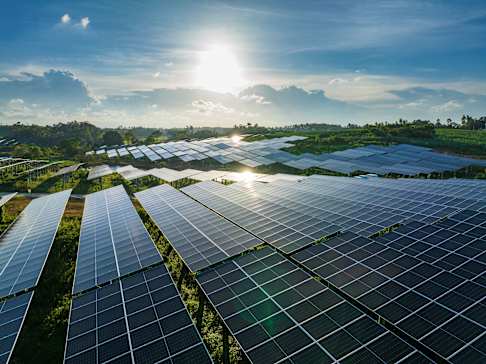
While not always practical, many data centers directly generate renewable energy or tap into local sources, whether that’s solar, hydroelectric, wind, or geothermal. Even if these sources aren’t sufficient to power a data center singlehandedly, they help decarbonize operations while ensuring access to reliable – albeit intermittent – power.
IDC’s research commissioned by Hitachi found that operators expect on-site generation, including the use of small nuclear reactors (SMRs), to be a significant trend in operations moving forward. Interviews with industry leaders found that limits to power availability will increasingly necessitate hybrid generation solutions to bridge the gap.
Onsite energy generation can also work in conjunction with BESS and microgrids to further improve efficiency, cost control, and operational resilience. That enables power use to be dynamic by optimizing how and when energy is generated, stored, and used. What's more, the ability to “island” data centers in real time insulates them from wider grid outages, improving operational resilience.
4. Deploy IT solutions
Alongside improvements to OT, it’s important to adopt the IT tools required to further optimize energy use. In particular, DCIM and power management software have a vital role to play in intelligently allocating capacity, cooling, and energy. Real-time data and predictive analytics, enable this kind of intelligent resource allocation, along with predictive maintenance to reduce failures and downtime.
These benefits are grounded in real-time visibility and monitoring. A comprehensive view of assets is vital, both to optimize their performance and measure any efficiency gains. This helps get buy-in from internal stakeholders, as well as informing ESG reporting. Especially in a climate of increasing costs and pressure to demonstrate ROI, data demonstrating efficiency and sustainability gains will be vital to drive investment in the investment required to transform data center operations.
Working within limits
Of course, not every solution outlined in this article will be relevant for your operations. It might be that onsite generation isn’t viable, or you already have the necessary scale without additional prefabricated infrastructure. But adopting some combination of these solutions will help prepare data center operations for an era that is likely to be defined by volatility and scarcity.
Grid access and energy availability are becoming strategic constraints for data centers, especially for new projects.
They are no longer just infrastructure inputs – they are potential limits to growth. The operators that thrive in this new reality will be those that prioritize flexibility and efficiency. Doing more with less and adapting to change. That’s what it means to work within those limits.
Grid access and energy availability are becoming strategic constraints for data centers, especially for new projects.
1 IDC Custom, commissioned by Hitachi, Voice of the Customer Study for Hitachi, doc#, April 2026